
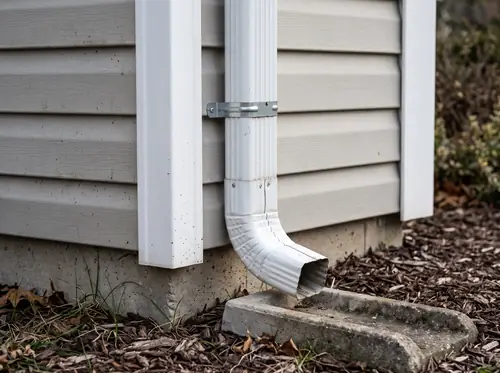
Why drainage is different here
Fayette County lies on the Lexington Limestone of the Inner Bluegrass. The Kentucky Geological Survey explains that karst sinkholes form when a fracture in the limestone is enlarged, and that a sinkhole is any depression into which rainfall drains. It also describes how soils over solution channels can settle for years and then collapse. Lexington, Georgetown, Winchester, Paris, Versailles and Nicholasville are all listed in the state's hazard plan as Inner Bluegrass karst cities.
That means water dumped at one spot does not just soak in evenly. It finds cracks, follows foundations and can concentrate where the ground is weak.
The options
| Option | Good for | Watch out for |
|---|---|---|
| Splash block | Most houses | Must slope away |
| Extension | Moving water further | Mowers, trip hazards |
| Buried drain line | Carrying water to a safe outlet | Roots, silt, settling |
| Rain barrel | Garden water | Overflow path |
| Rain garden | Lots with room | Keep away from foundations and sinkholes |
The stormwater fee
All developed properties in Lexington-Fayette pay the Water Quality Management Fee. Single-family homes and duplexes pay 1 ERU a month; other properties pay per 2,500 square feet of impervious surface, which includes roofs. The city's incentive grants help neighborhoods and organizations fund rain gardens and rainwater harvesting.
What to ask a contractor
- Where will each downspout end?
- Will the water reach ground that slopes away?
- Should any old buried line be tested or brought above ground?
- Is there a sinkhole or low spot nearby to keep water away from?
See karst, sinkholes and downspouts and basement and crawl space water.
Reading your yard after a storm
Walk the yard the day after a big rain. Look for:
- Puddles near the foundation
- Washed-out mulch or soil at downspout ends
- Water flowing toward the house from a neighbor's lot
- Low spots that hold water for days
- Any new depression or hole
Each tells you something about where roof water goes. Fix the downspouts first, then look at grading.
Neighbors
Do not send roof water onto a neighbor's lot. If water from next door is reaching your house, talk to them before changing your own drainage.
Key points
- Lexington sits on karst limestone, where water follows cracks.
- Carry downspout water several feet onto ground that slopes away.
- Never pipe roof water into a sinkhole or onto a neighbor's lot.
- Test old buried lines before tying new downspouts in.