
On this page
- What does a new gutter system include?
- How a seamless gutter goes up
- What size does a Lexington house need?
- Which material?
- Installation types
- Local conditions an installer should plan for
- What to ask an installer
- Choosing gutters for a Lexington house
- Installation day
- Gutters for each kind of Lexington house
What does a new gutter system include?
The trough is only one piece. A complete installation runs from the metal at the roof edge to the spot where the water soaks in or drains away, and a fair quote names each part.
| Part | Job it does | What the quote should say |
|---|---|---|
| Drip edge or gutter apron | Sends roof water into the gutter, not behind it | Whether one is there, or will be added |
| Fascia | The board the gutter screws into | How it will be checked; price per foot to replace |
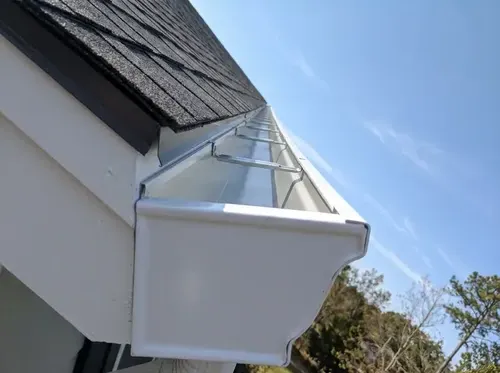
| Gutter | The trough, K-style or half-round | Size (5 or 6 inch) and metal thickness |
| Hidden hangers | Brackets inside the gutter that hold it to the fascia | Type and spacing |
| Corners | Inside and outside miters | How they are joined and sealed |
| End caps | Close off each run | Crimped and sealed |
| Outlets | Where water drops into the downspout | Size and number |
| Elbows and downspouts | Carry water down the wall | Size (2x3 or 3x4), count and straps |
| Discharge | Extensions, splash blocks or drain lines | Where each downspout ends |
How a seamless gutter goes up
- Survey the roof. The installer measures each eave and works out which roof planes feed which run.
- Check the wood. Fascia and rafter tails are probed for rot.
- Strip the old system. Spikes, straps and downspouts come off, and bad boards are replaced.
- Form the gutter. A machine on a trailer turns a coil of painted aluminum into one length for each run.
- Set the fall. A chalk line gives each run a slight drop to its outlet. Long runs may slope both ways from the middle.
- Hang it. Outlets are punched, and the gutter is lifted and screwed through hidden hangers into the fascia.
- Close the joints. Corners are mitered, riveted and sealed; end caps are crimped and sealed.
- Bring it down. Elbows and downspouts are fitted, strapped and finished with extensions or splash blocks.
- Run water. A hose in each run shows whether it drains and clears the downspout.
What size does a Lexington house need?
Lexington averages about 49.84 inches of precipitation a year, and its wet years run much higher: 71.98 inches in 2018. In early April 2025, Blue Grass Airport recorded 8.14 inches in five days. Gutters need to handle the hard spring storms, not just the average.
| House | Typical size | Downspouts |
|---|---|---|
| Craftsman bungalow in Kenwick | 5-inch, 6-inch where the porch roof ties in | 2x3 or 3x4, four to six |
| One-story brick ranch | 5-inch | 2x3 or 3x4, four to six |
| Two-story house in Hamburg or Masterson Station | 5-inch on fronts, 6-inch on long back runs | 3x4, six to ten |
| Large house with many valleys | 6-inch | 3x4, with outlets near valleys |
| Historic house near downtown | Half-round, sometimes copper | Round, 3 or 4-inch |
Which material?
Aluminum is the default. It is light, does not rust, comes in many baked-on colors and can be rolled seamless on site. Ask for .032-inch coil on two-story houses and long runs. Copper suits historic houses and lasts for generations at several times the price. Galvanized steel is strong but rusts once its coating is scratched.
Installation types
- Seamless gutters: one piece per run, joints only at corners and outlets.
- 6-inch gutters: for large or steep roofs and long runs.
- Half-round gutters: for older and historic houses.
- Copper gutters: for historic houses and estates.
- Aluminum gutters: the standard choice.
- Downspouts: sizing, placement and drainage.
Local conditions an installer should plan for
Ice. In February 2003, ice approached an inch on exposed branches in Lexington. Hangers at close spacing, screwed into sound wood, keep a gutter on the house under ice and falling limbs.
Limestone and sinkholes. Fayette County lies on the Lexington Limestone, a karst landscape. Plan where each downspout ends before the gutter goes up, and keep water away from foundations and sinkholes.
Trees. Older neighborhoods sit under mature trees, and the emerald ash borer has left many dying ash trees that shed twigs and limbs.
Historic districts. In Lexington's H-1 overlay districts, exterior changes need a Certificate of Appropriateness.
What to ask an installer
- What size and thickness are you quoting, and why that size for this roof?
- How many downspouts, what size, and where will each one discharge?
- What hangers, at what spacing, screwed into what?
- How will you check the fascia, and how is rotten wood priced?
- Is the house in an H-1 district, or does my HOA have color rules?
- Are you registered with Lexington-Fayette, and can you show a certificate of insurance?
See what gutters cost in Lexington for price ranges.
Choosing gutters for a Lexington house
| Decision | Common choice | When to choose differently |
|---|---|---|
| Size | 5-inch K-style | 6-inch on two-story roofs, valleys and long runs |
| Metal | Seamless aluminum | Copper or half-round on historic houses |
| Thickness | .027-inch | .032-inch on tall walls, under trees, where ice builds |
| Hangers | Hidden, 24 inches apart | Closer under trees and on exposed walls |
| Downspouts | 2x3 | 3x4 on big roofs and with 6-inch gutters |
| Discharge | Extension or splash block | Tested drain line to a safe outlet |
Installation day
- Old gutters come down and are hauled away.
- Fascia is probed; soft boards are replaced.
- Drip edge is added or checked.
- The machine forms each run to length.
- Gutters are hung with a gentle fall to each outlet.
- Corners are riveted and sealed; end caps sealed.
- Downspouts are strapped and their ends set.
- Water is run through every gutter.
Most houses are done in a day unless there is a lot of wood repair. See what gutters cost in Lexington.
Gutters for each kind of Lexington house
| House | What usually goes up |
|---|---|
| Craftsman bungalow in Kenwick | 5-inch K-style or half-round; extra outlet at the porch |
| Revival house in Chevy Chase | Half-round or K-style; guards under the canopy |
| Brick ranch | 5-inch K-style on all four sides of a hip roof |
| Two-story subdivision house | 6-inch on back runs, 3x4 downspouts |
| Historic house downtown | Copper, half-round or a relined box gutter |
| Barn or stable | 6-inch or commercial profile |
Every one of them needs the same thing at the bottom: downspouts that carry water away from a foundation sitting on limestone.