
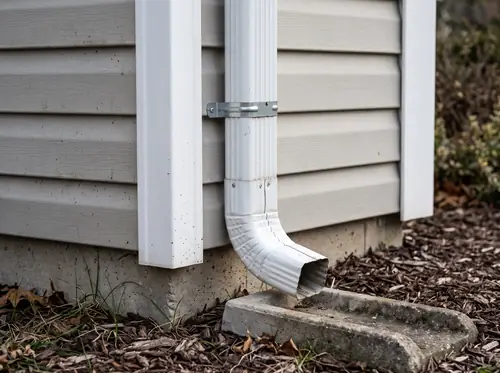
Why downspouts matter on limestone
Fayette County lies on the Lexington Limestone of the Inner Bluegrass. Water dissolves limestone along its cracks, and the Kentucky Geological Survey defines a sinkhole as any depression into which rainfall drains. It also notes that soils over bedrock solution channels can settle and wash out. Water dumped at the corner of a house can follow cracks down to the basement, or concentrate where the ground is already weak.
Sizing
| Downspout | Carries | Use with |
|---|---|---|
| 2x3 rectangular | Standard | 5-inch gutters on small roofs |
| 3x4 rectangular | Much more | 6-inch gutters, two-story houses, valleys |
| 3-inch round | Similar to 2x3 | 5-inch half-round |
| 4-inch round | Similar to 3x4 | 6-inch half-round |
Placement
- Corners and ends. Each run needs an outlet; long runs need one at each end.
- Below valleys and tie-ins. These pour a lot of water into a short length of gutter.
- Away from steps, walks and the AC pad.
- On the side where water can get away, toward ground that slopes off the lot.
Where the water goes
| Option | Good for | Watch for |
|---|---|---|
| Splash block | Most houses | Must slope away from the wall |
| Extension | Moving water several feet further | Trip hazard, mowers |
| Buried drain line | Carrying water to a safe outlet | Roots, silt, collapse; test old lines |
| Rain barrel | Garden water | Overflow path |
| Rain garden | Lots with room | Siting; keep away from foundations and sinkholes |
See rain gardens and the stormwater fee.
Strapping for ice and wind
Downspouts catch wind and ice. Two straps minimum, more on tall drops, screwed into solid wood or masonry anchors.
See also downspout repair, karst, sinkholes and downspouts and basement and crawl space water.
Extensions that survive mowing
The most common downspout problem is an extension that has been taken off for mowing and never put back.
| Option | Good for |
|---|---|
| Flip-up extension | Lawns that get mowed |
| Roll-out sleeve | Light rain; can tear |
| Fixed extension with splash block | Beds and borders |
| Buried line to a pop-up outlet | Lawns, if the line is laid with fall |
Downspout count
A common rule is one downspout for every 30 to 40 feet of gutter, plus one near every valley. Lexington's wet springs, like April 2011 with 12.70 inches, show which houses need more.
In short
Downspouts decide where roof water goes. On karst limestone, getting it several feet from the foundation matters more than almost any other gutter detail.