
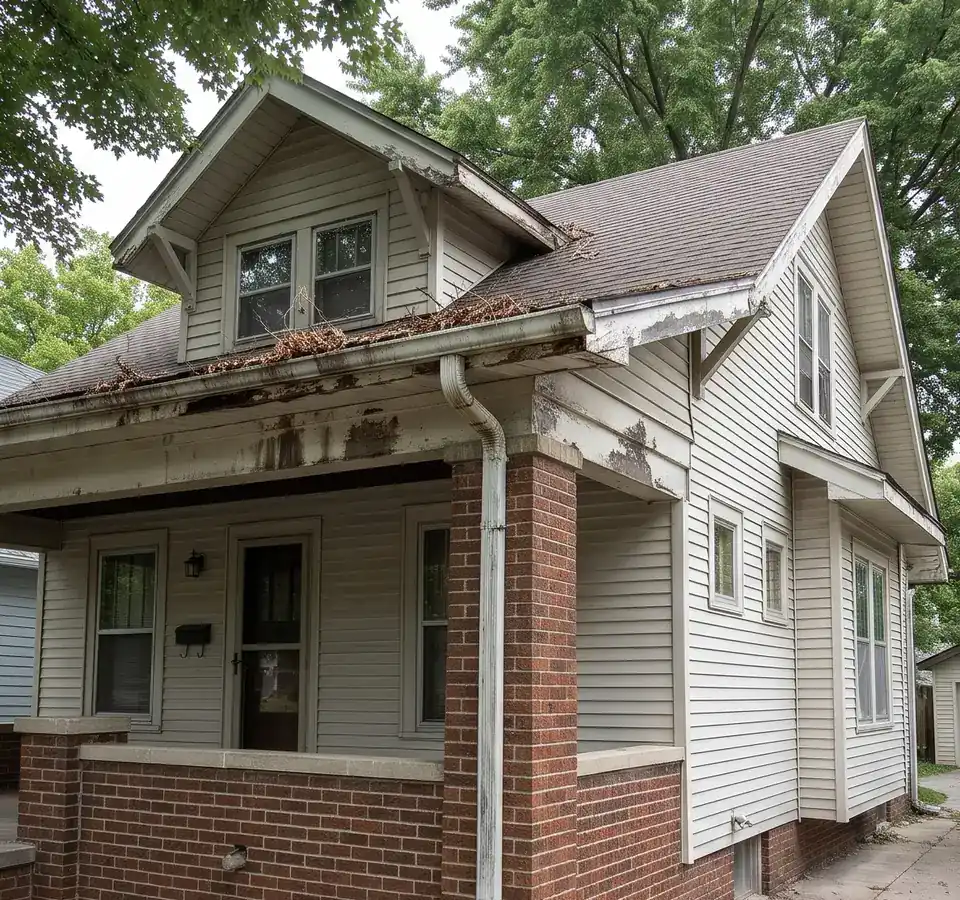
Signs it is time for new gutters
- Several joints leak, and resealing one moves the drip to the next.
- The gutters are old sectional pieces with seams every few feet.
- Runs sag between hangers in more than one place.
- Ice or a storm has bent most of a side.
- Paint is peeling and the wood is soft along much of the fascia.
- Downspouts are crushed, split or too small for the roof.
What a replacement includes
- Removal. Old gutters, spikes, hangers and downspouts are taken down and hauled away.
- Wood check. The fascia and rafter ends are probed, and bad boards replaced.
- Roof edge. Drip edge is added where missing, so water lands in the gutter.
- New gutters. Seamless runs formed on site, pitched and fastened through hidden hangers.
- Downspouts. Sized for the roof, strapped and carried away from the foundation.
- Test. Water is run through each gutter before the crew leaves.
Replacing after an ice storm
When freezing rain coats the Bluegrass, many houses need work at once. After the February 2003 storm, the Lexington area had 115,000 Kentucky Utilities customers without power and extensive tree damage. If ice or limbs damaged your gutters:
- Photograph each side of the house before anything is moved.
- Get the roof covered first if it is open.
- Keep damaged pieces until your insurer has seen them.
- Get a written quote, and be wary of anyone who wants cash up front or pressures you to sign that day.
Choosing the new system
Most replacements here go to seamless aluminum K-style, in 5-inch or 6-inch. On historic houses, half-round may suit better, and in Lexington's H-1 districts exterior changes need a Certificate of Appropriateness. See 5-inch vs 6-inch gutters and aluminum vs steel vs copper.
Signs it is time
| Sign | What it suggests |
|---|---|
| Leaks at most joints | Sectional gutters at the end of their life |
| Several sagging runs | Hangers and wood failing along the house |
| Bent runs after an ice storm | Aluminum that will not straighten well |
| Overflow when clean | Gutters too small for the roof |
| Rust | Old steel gutters |
| Fascia rot along much of the house | Long-term water behind the gutters |
What changes when you replace
Replacement is the chance to fix everything at once: size, downspout count, hanger spacing, coil thickness, drip edge and where the water goes. Ask the contractor what they would change from the old system and why.
Lexington's ice storms in 2003 and 2009 showed which houses had gutters that held. The ones that did had hidden hangers at close spacing, screwed into sound wood.
See repair or replace gutters and seamless gutters.
A replacement checklist
- Measure every eave that needs a gutter.
- Decide sizes run by run: 5-inch or 6-inch.
- Decide downspout count and size, and where each will end.
- Ask about coil thickness and hanger spacing.
- Ask how fascia repair will be priced.
- Check H-1 or HOA rules if they apply.
- Get written quotes and compare them line by line.
- Check registration and insurance.