
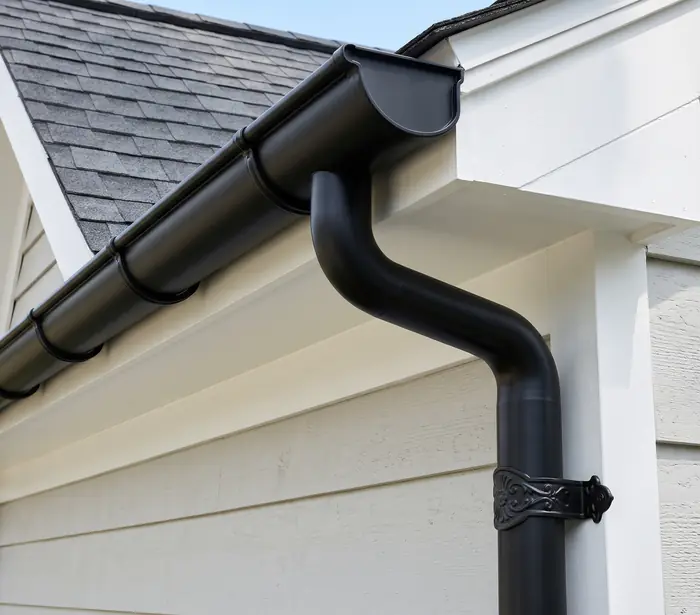
Profile first
| Profile | Suits |
|---|---|
| K-style | Most houses from the mid-20th century on |
| Half-round | Older and historic houses, some new traditional designs |
| Box or commercial | Larger buildings and barns |
| Built-in box gutters | Some historic buildings; reline rather than replace |
See half-round gutters.
Colors
| House | Colors that usually work |
|---|---|
| White or light painted trim | White |
| Red brick with white trim | White, or dark bronze to recede |
| Red brick with dark trim | Dark bronze, black |
| Gray or blue siding | White, gray, black |
| Stone farmhouse | Dark bronze, black or copper |
| Newer house with dark windows | Black |
Downspout placement
Downspouts are the most visible part of the system. Put them at corners where possible, away from the front door and porch steps, and where their water can get away from the house. A downspout in the middle of a front wall is sometimes needed under a valley, but it should be planned, not an afterthought.
Copper
Copper gutters start bright, turn brown and slowly go green. On stone and brick estate houses around the Bluegrass farms, many owners choose copper for that reason.
Historic districts
In the H-1 overlay, a change in gutter profile or material needs a Certificate of Appropriateness, but the city's code says changing the paint color of a previously painted surface does not.
Key points
- Match the profile to the house first.
- Gutters usually match the trim.
- Plan downspout placement as carefully as color.
- Check HOA and H-1 rules before changing the look.