
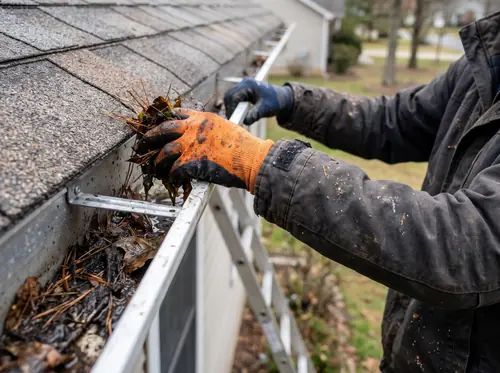
Ladder basics
| Rule | Why |
|---|---|
| Firm, level ground | Soft lawns let feet sink |
| Use a stand-off | Keeps weight off the gutter |
| Three points of contact | Two feet and a hand |
| Do not overreach | Move the ladder instead |
| Clear of overhead lines | Ladders and gutters conduct electricity |
| Someone to foot the ladder | Especially on tall walls |
Ice and snow
Lexington averages 14.5 inches of snow a season, and ice storms such as 2003 coat roofs, ladders and ground. Do not work on gutters in ice. Let it melt, then look from the ground.
Power lines
- Look up before setting a ladder.
- Keep ladders and gutter sections away from the service line.
- After storms, treat any downed or sagging line as live. Call 911 and your utility.
- Do not touch a gutter or downspout a line is lying on.
Walkout basements
Many houses on sloping lots have a back wall a full story taller than the front. Ladders get long fast. Leave those walls to a contractor.
When to call a contractor
- Two-story walls and walkouts
- Anything near the service line
- Damaged roof edges after storms
- Ice on the roof
- When you are not comfortable at height
See gutter cleaning.
A safe setup, step by step
- Check the weather. No wind, rain or ice.
- Look up for the service line and any branches.
- Set the ladder on firm, level ground, at about one foot out for every four feet up.
- Use a stand-off so the ladder does not rest on the gutter.
- Have someone hold the ladder.
- Keep your belt buckle between the rails.
- Move the ladder rather than reaching.
- Carry tools in a bucket on a hook, not in your hands.
Walkouts and slopes
On sloping lots, one side of the house can be much taller than the other. Ladders on slopes need leveling feet or a level base. If in doubt, hire it out.
Key points
- Never lean a ladder on the gutter; use a stand-off.
- Look up for the service line before setting a ladder.
- Stay off ladders in ice and wind.
- Leave two-story walls and walkouts to a contractor.