
Storm history
The National Weather Service's Fayette County tornado records include an F2 on March 10, 1986 that it calls one of the worst tornadoes ever to strike Lexington, with 20 injuries along a three and a half mile path. More often, damage comes from spring and summer thunderstorms with strong wind, hail and falling limbs.
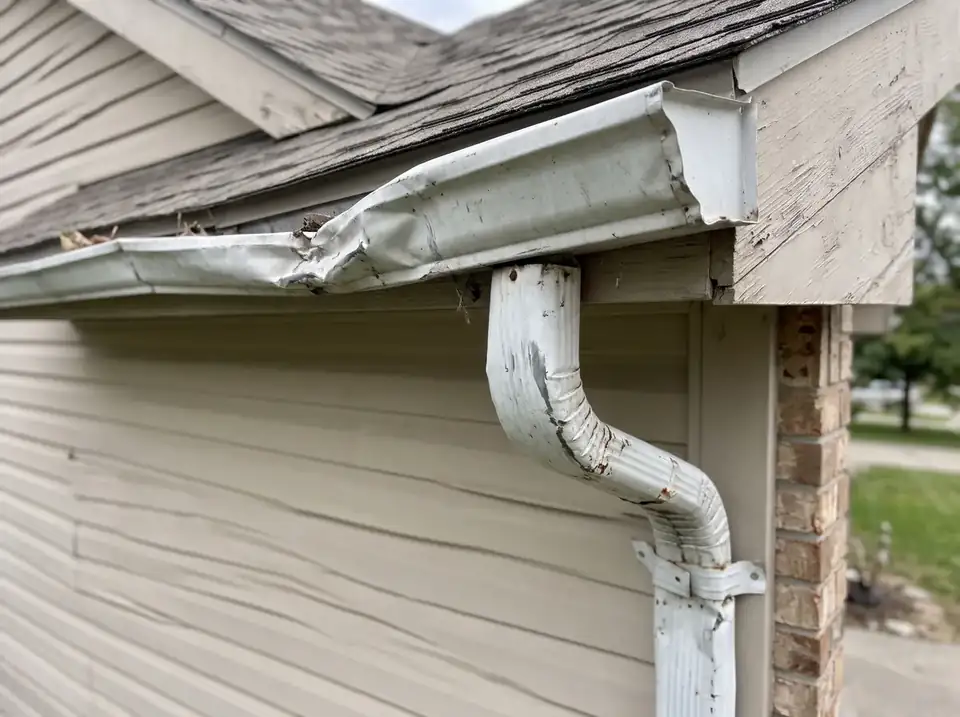
What wind and hail do
| Damage | Cause |
|---|---|
| Runs lifted and twisted | Wind under the front lip |
| Dented fronts | Hail |
| Crushed downspouts | Hail and debris |
| Bent roof edge | Falling limbs |
| Torn straps | Wind on tall downspouts |
After the storm
- Stay clear of downed lines.
- Cover any open roof.
- Photograph everything before moving it.
- Call your insurer.
- Get written quotes from contractors who are registered where required.
Avoiding storm chasers
Do not pay in full up front, sign over insurance checks, or sign on the spot. The FTC's Cooling-Off Rule usually gives three business days to cancel a contract signed at home after a salesperson came to you.
Rebuilding stronger
- Hidden hangers at close spacing, screwed into sound wood
- .032-inch aluminum on exposed sides
- Riveted, sealed corners
- Two or more straps per downspout
- Dead limbs over the roof trimmed
See storm damage repair.
Hail dents and what they mean
| Dent | Usually |
|---|---|
| Small dimples on the front face | Cosmetic |
| Dents along the top lip | May affect flow if deep |
| Creases across the gutter | Weakened; may need replacing |
| Crushed downspouts | Replace sections |
Your insurer decides what is covered. Photograph damage clearly, with something in the frame for scale.
Wind and hanger type
Hidden hangers hold the front lip of a gutter as well as the back. Old spike-and-ferrule systems hold only through the face, and wind gets under them more easily.
Key points
- The 1986 F2 tornado was one of the worst to strike Lexington.
- Most storm damage comes from wind, hail and falling limbs.
- Photograph everything before it is moved.
- Use registered, insured contractors and get written quotes.