
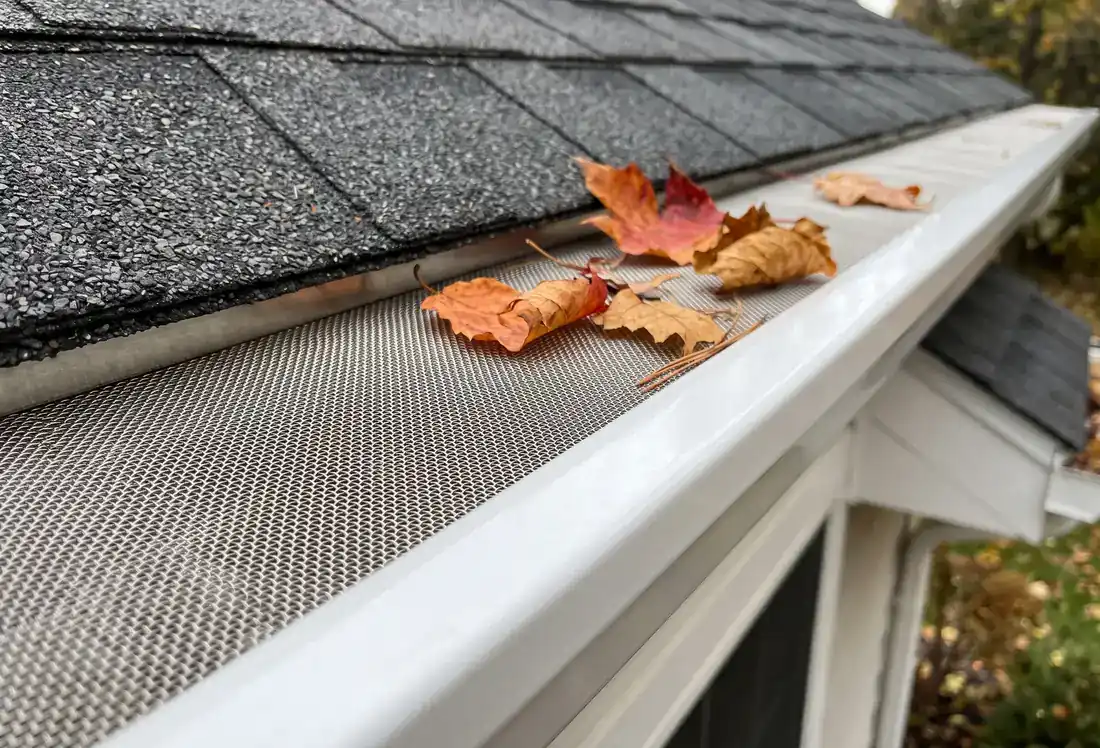
Why micro-mesh works under Lexington trees
Lexington's older neighborhoods sit under mature shade trees, and dying ash trees, hit by the emerald ash borer, drop twigs and branches. Maple seeds and pine needles slip through open screens; fine stainless mesh stops them.
How it is fitted
- Gutters cleaned and flushed.
- Hangers checked and pitch corrected.
- Guard frame screwed to the front lip.
- Back edge set as the maker specifies.
- Corners and run ends trimmed and closed.
Upkeep
| Task | How often |
|---|---|
| Look up after storms | After each big storm |
| Brush or rinse the mesh | Once or twice a year |
| Check downspouts | Once a year |
When micro-mesh is the wrong choice
- The gutter is too small and overflows when clean.
- The fascia is soft. Fix the wood first.
- The roof sheds a lot of grit, which can coat fine mesh quickly.
See screens and reverse-curve guards and are gutter guards worth it.
Micro-mesh and the stormwater picture
A guard keeps leaves out of your downspouts and drain lines, so water keeps flowing to the splash block or rain barrel instead of overflowing at the foundation. If you collect roof water in a rain barrel, a guard also keeps leaves out of the barrel. Lexington's neighborhood stormwater grants can help associations fund rain barrels.
What to ask
- Stainless mesh or aluminum?
- Rigid frame or flexible?
- Screwed to the gutter, or clipped?
- What does the maker's warranty cover?
In short
Stainless micro-mesh stops the seeds, needles and twigs that slip through coarser guards. It still needs an occasional brush, and it cannot fix undersized or poorly pitched gutters.