
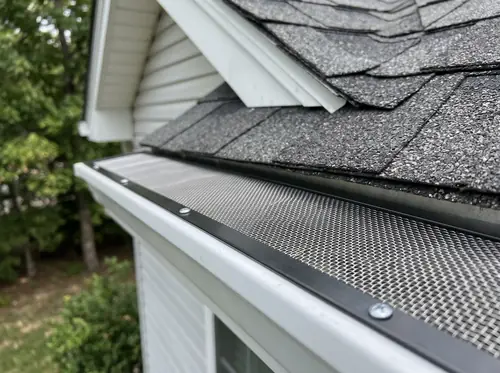
The options
| Type | How it works | Cost | Under Lexington trees |
|---|---|---|---|
| Plastic screen | Snaps into the gutter | Low | Seeds and needles lodge; brittle |
| Perforated aluminum | Metal sheet with holes | Low to moderate | Better; needles still lodge |
| Reverse-curve cover | Solid hood; water follows the curve | Moderate to high | Leaves slide off; can overshoot |
| Foam or brush insert | Fills the trough | Low | Holds debris |
| Stainless micro-mesh | Fine mesh on a frame | Higher | Best all-round |
Why heavy rain matters
Lexington's wettest years have topped 70 inches. A guard that sheds water past the gutter in a hard storm puts it on the ground beside the foundation, exactly where you do not want it.
When a screen makes sense
- Short term, on a house that will be re-guttered soon.
- On a run with only big, flat leaves above it.
- On a tight budget, knowing it will need replacing.
See gutter guards and are gutter guards worth it.
Taking out old screens
Many houses have old plastic or metal screens that have warped, broken or filled with seeds. Before new guards go on, the old ones come off and the gutters are cleaned and checked. That is often when loose hangers and soft fascia turn up.
Covers and ice
Reverse-curve covers shed water over a curved edge. In freezing rain, ice can build along that edge and the eave. They are not a fix for ice.
In short
Screens and covers are cheaper than micro-mesh but tend to let seeds and needles lodge, or let water overshoot in heavy rain. They can suit short-term or low-tree situations.